As an Amazon Associate I earn from qualifying purchases. These links may earn this site a commission when you buy, at no extra cost to you.
Riding safety hinges on properly inflated tires, and choosing the right tire gauge is essential for every rider. This guide reviews five top picks that cover digital and analog options, offering solid accuracy, durable builds, and user-friendly features for motorcycles and other vehicles. Each selection balances range, readability, and reliability, helping you pick a gauge that suits your bike, riding style, and maintenance routine.
| Product | Brand | Range | Type |
|---|---|---|---|
| JACO ElitePro Digital Gauge 200 PSI | JACO Superior Products | 0-200 PSI | Digital |
| ETENWOLF T300 Digital Gauge 3-200 PSI | ETENWOLF | 3-200 PSI | Digital |
| Counteract MKPG-D Analog Gauge 5-50 PSI | Counteract | 5-50 PSI | Analog |
| JACO ElitePro Digital Tire Gauge 100 PSI | JACO Superior Products | 0-100 PSI | Digital |
| PUIBERS Motorcycle Tire Gauge 60 PSI | PUIBERS | 0-60 PSI | Analog |
JACO ElitePro Digital Gauge 200 PSI

The JACO ElitePro Digital Gauge 200 PSI combines professional-grade precision with a rugged footprint. It uses dual pressure sensors calibrated to ANSI 2A standards, delivering readings with an accuracy as precise as ±0.50% FS (about 1 PSI). The device reads up to 200 PSI, with a fine 0.10 PSI readout resolution for exact adjustments on motorcycle tires, trailers, or cars. Construction emphasizes durability, using solid brass and steel parts protected by a gear-style guard to resist drops and impacts. A 10-inch HybridFlex hose and 360-degree swivel chuck enhance accessibility for hard-to-reach valves, while the built-in air bleeder allows real-time pressure relief without resetting the display. Readings lock on until reset, helping ensure consistent measurements during inspection or maintenance.
Operability prioritizes efficiency: the tool is designed for quick, shop-grade accuracy in a handheld form. It suits riders who demand dependable performance from a tool that might see regular use on a variety of vehicles. Its robust design and long hose are ideal for both street bikes and touring setups, where tire pressures can vary significantly with load, speed, and weather. While digital gauges often rely on battery power, this model’s emphasis remains on precision, durability, and ease of use under real-world riding conditions.
ETENWOLF T300 Digital Tire Gauge 3-200 PSI

The ETENWOLF T300 Digital Tire Pressure Gauge covers a broad 3-200 PSI range and is calibrated to ANSI B40.7 Grade 2A within a ±1 PSI tolerance. The design emphasizes reliability in diverse conditions, with a thermal compensation AI chip that helps maintain accuracy in extreme temperatures from -4°F to 130°F (-20°C to 54°C). This capability is valuable for riders who encounter cold mornings or hot夏 days, ensuring pressure readings stay consistent. The device uses replaceable AAA batteries, which supports easy maintenance and extended usability in field scenarios.
Readability and performance complement its engineering. The digital display offers clear, quick readings, and the gauge is built to withstand environmental stress while maintaining precision across a wide thermal range. Its battery-based operation can be advantageous for riders who prefer LCD readability in dim lighting or need consistent performance across fluctuating weather. This model is well-suited for riders who maintain diverse fleets or frequently switch between motorcycles and other vehicles in variable climates.
Counteract MKPG-D Analog Gauge 5-50 PSI

The Counteract MKPG-D analog gauge is tailored for motorcycle and ATV tires, offering a 5-50 PSI readout in a compact, all-metal package. Its 90-degree head design helps reach valve stems in tight or awkward angles, a common scenario on sport bikes or dual-sport motorcycles. The mechanical bourdon tube delivers direct, battery-free readings with no electronics to fail in adverse conditions. The red-to-green color cues on the dial assist quick interpretation, and the black anodized body provides durability for field maintenance and trail use. This gauge prioritizes simplicity and rugged reliability over digital features.
Analogue gauges have a straightforward workflow: attach the chuck, read the dial, and adjust as needed with a bleeder valve or by releasing air. The MKPG-D’s 5-50 PSI range aligns well with common motorcycle tire pressures, particularly for sport or off-road setups. While it lacks digital precision, its robustness and immediate feedback can be advantageous for riders who prefer zero-battery operation and minimal calibration concerns. It’s a practical choice for riders seeking a reliable, no-frills option for on-the-road checks.
JACO ElitePro Digital Tire Gauge 100 PSI
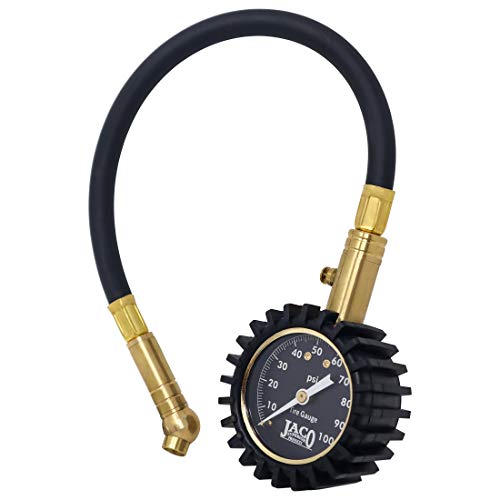
This JACO ElitePro model offers professional-grade accuracy within a 0-100 PSI range, ideal for most motorcycle tires that run below 50 psi under normal conditions. It features dual pressure sensors with ANSI 2A-style precision, achieving readings with a stated accuracy of about ±0.50% FS (0.50 PSI). The 10-inch HybridFlex hose and 360-degree swivel chuck provide flexible access to valve stems from tight spots. A built-in air bleeder reduces overinflation on the fly, and readings lock onto the display until reset, making it simple to verify consecutive checks during tire maintenance on longer rides or race preparation setups.
The ElitePro 100 PSI variant emphasizes a compact footprint while maintaining the hallmark durability of JACO’s design philosophy. It’s well-suited for riders who primarily work with standard street or sport motorcycle tires that don’t require very high pressures. The device’s robust construction, shielded by a protective guard, minimizes damage from accidental drops or impacts on the road or in the workshop. For riders seeking frequent digital measurements with dependable precision, this gauge remains a solid option.
PUIBERS Motorcycle Tire Gauge 60 PSI

The PUIBERS gauge appeals to riders seeking a simple, battery-free solution with a clear dial. It uses a bronze bourdon tube mechanism and a 60 PSI maximum range, which covers common motorcycle tire pressures for many bikes. The dial is luminous for easier reading in low light, and the 90-degree right-angle chuck helps access valves on crowded rims or tight wheel wells. While it lacks digital features, its all-brass construction and straightforward operation provide reliable performance for routine tire checks, maintenance, and field adjustments on the road or trail.
Because it operates without batteries, the PUIBERS gauge is particularly useful for riders who value minimal maintenance and durability. The combination of a robust build, readable glow-in-the-dark dial, and precise 60 PSI range makes it a dependable option for riders who mainly service standard motorcycles or want a lightweight, budget-friendly tool for quick checks during rides.
Buying Guide
Key purchase considerations help you choose the right gauge for your motorcycle and riding style. Start by deciding between digital versus analog, balancing accuracy, ease of use, and battery needs. Digital models typically offer higher precision, clear displays, and features such as auto lock-on, real-time bleed, and large screens, but rely on batteries. Analog gauges are battery-free, rugged, and instantly readable, though they may require calibration checks and can be harder to read in low light.
- Measurement range: For most motorcycles, a gauge covering at least 0-60 PSI is common, with some riders preferring up to 200 PSI for trucks or touring vehicles. Ensure the range matches your tire pressures under typical loads and speeds.
- Accuracy and resolution: Look for models that specify ANSI/B40.7-grade accuracy. A smaller readout increment (like 0.1 PSI) helps when adjusting tires for performance or comfort.
- Durability and materials: Metal bodies, brass components, and protective guards increase resilience after drops. A long, flexible hose and a 360-degree swivel chuck improve accessibility on tight or wide rims alike.
- Readability: A bright, legible display or luminous dial is important for dawn or night rides. Backlit digital screens or glow-in-the-dark dials improve visibility when on the road.
- Battery life and maintenance: Digital gauges require batteries or replacements. Consider how frequently you’ll use the gauge and whether you want a model with easy battery access.
- Calibration and maintenance: Some gauges offer auto-zero, lock-on readings, or built-in bleed valves. Choose a tool that aligns with how you monitor and adjust tire pressures during routine maintenance.
- Valve compatibility and chuck design: A 90-degree chuck helps reach recessed stems, while a straight chuck suits broader access. A flexible hose length reduces strain while inflating.
- Portability and weight: If you carry a gauge on trips, a compact, lightweight model with a durable case is convenient for roadside checks or track days.
In practice, digital gauges with broad ranges and robust housings are excellent all-around tools for riders who service multiple vehicles or ride in varied conditions. Analog gauges excel when you want a battery-free option that is straightforward and rugged for everyday use or emergency roadside checks. When choosing, map your typical tire pressures, preferred format, and maintenance cadence to find the best balance of accuracy, durability, and practicality for your motorcycle needs.