
Best Portable Marine Radios for Safe, Clear on-Water Communication
A reliable handheld marine radio is essential for safety and coordination on any watercraft. The following five models balance portability, durability, and feature sets—from NOAA weather alerts to floating designs—so you can pick the best fit for your boat, kayak, or cruiser.
| Product | Brand | Key Feature |
|---|---|---|
| Cobra MR HH350 FLT | COBRA | 6W, Floats, Noise-Cancel Mic |
| Uniden Atlantis 275 | Uniden | 6W, Strobe Light, Flashlight |
| Cobra MR HH150 FLT | COBRA | 3W, Floats, NOAA Weather Alerts |
| Uniden MHS75 | Uniden | JIS8 Waterproof, 1/2.5/5W |
| Uniden Atlantis 155 | Uniden | Floating, Large LCD, NOAA Alert |
Cobra MR HH350 FLT Handheld Floating VHF Marine Radio

The Cobra MR HH350 FLT is a compact handheld VHF radio designed for easy access on deck, in a dinghy, or during a overboard scenario. It delivers up to 6 watts of VHF power for longer reach, and its noise-cancelling microphone helps reduce background chatter in windy or busy marinas. The Backlit Plus Floats design features an orange display and an orange core that floats for quick retrieval in rough conditions. This model emphasizes practical reach and reliability on the water.
Other notable features include a backlit orange display for visibility in low light, access to NOAA weather channels, and a memory scan option to cycle through recent conversations. Its floating design reduces the risk of losing signal and makes it simple to recover if dropped overboard, making it a versatile choice for day trips and coastal cruising.
Uniden Atlantis 275 Handheld VHF Marine Radio
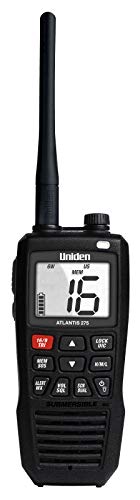
The Uniden Atlantis 275 offers 6 watts of power in a compact, floating handheld with safety-focused extras. It ships with an Emergency Strobe Light and a built-in Flashlight, enhancing visibility during emergencies or low-light checks. The Atlantis 275 prioritizes readability and readiness for rapid response in rough seas and crowded harbor channels.
Its display is designed for easy daytime and nighttime use—the largest LCD in its class at approximately 25mm by 40mm—with paper white backlight for day and red backlight for night. Built to U.S., international, and Canadian channels, the Atlantis 275 also provides durable, submersible protection through IPX8 specifications, ensuring functionality after splashes or brief immersion.
Cobra MR HH150 FLT VHF Marine Radio

The Cobra MR HH150 FLT is a lightweight 3-watt option that floats, making it suitable for smaller boats or tight spaces. Its orange core and floating design help locate the radio quickly if it’s dropped overboard. The HH150 remains designed for marine use with a waterproof build that withstands common splashes and rain, while still offering long-range capability within its 3-watt setting.
Key safety features include NOAA weather alerts to keep you informed about approaching conditions. This model pairs simplicity with essential long-range communication, making it a practical choice for casual boating, fishing trips, or back-to-bay exploration where ease of use matters most.
Uniden MHS75 Waterproof Handheld VHF Marine Radio

The Uniden MHS75 is built for rugged marine use with a JIS8 waterproof rating and floating design. It provides a flexible 1/2.5/5 watt transmit power to balance battery life and communication needs on varying watercraft. The radio is designed to perform in wet conditions while remaining portable enough to carry on deck or stow in a pocket or life jacket.
All USA, international, and Canadian marine channels are covered, and the MHS75 includes features like triple-watch monitoring and DSC capabilities. Its durable construction and multi-band compatibility make it a reliable everyday companion for coastal boating and offshore excursions alike.
Uniden Atlantis 155 Handheld VHF Marine Radio
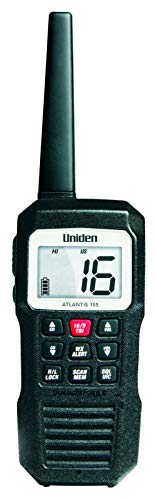
The Uniden Atlantis 155 is designed for extended time on the water with a floating, submersible form factor. It features a large LCD and dual-color day/night backlighting, prioritizing readability under sun glare or low light. NOAA Weather Alerts keep you informed of changing conditions, while the radio supports all USA, international, and Canadian channels for broad maritime reach.
Battery life is a focal point, with up to about 10 hours of operation on a single charge in typical use. The Atlantis 155 emphasizes a balance of display clarity, durability, and practical standby performance for long boating days and multi-day adventures.
Buying Guide
Choosing the right portable marine radio depends on your typical boating scenario and environment. Consider these factors to match a model to your needs:
- Power and range: Higher wattage (1, 3, 6 watts) generally provides longer reach, especially on larger vessels or open-water routes. Balance power with battery life and device weight.
- Water resistance and flotation: Look for floating designs and IPX or JIS ratings. Floating radios reduce loss when dropped, while higher ratings tolerate splashes, rain, or brief immersion.
- Display readability: A bright backlit or dual-color LCD helps with quick reads in bright sun or at night. Large displays improve ease of use while underway.
- Safety features: NOAA weather alerts, Channel 16 access, DSC capabilities, and emergency strobe or flashlight features can be crucial in deteriorating conditions.
- Channel coverage: Ensure the radio supports the US, international, and Canadian marine channels if you frequently navigate near borders or international waters.
- Battery life and charging: Consider battery type, endurance hours, and charging options (USB, dock, or included charger) to fit your cruising schedule.
- Additional capabilities: GPS, Bluetooth, memory scan, and weather-related alerts vary by model and add convenience in different use cases.
For most day-use boats and kayaks near shore, a 3–6 watt handheld with floating design and NOAA alerts provides robust performance. For longer excursions or larger vessels, prioritizing 6W power, a larger display, and IPX8-rated protection can improve resilience and readability in challenging conditions. Always test your radio in a safe environment before heading offshore to ensure coverage and features align with your navigation and safety plans.