As an Amazon Associate I earn from qualifying purchases. These links may earn this site a commission when you buy, at no extra cost to you.
If you need a dependable gauge to monitor fuel or other liquid levels in cylindrical farm tanks, vertical oil tanks, or propane tanks, these five options offer clear readings, sturdy construction, and straightforward installation. This guide helps buyers choose gauges that fit common tank openings, provide accurate float-based readings, and suit different tank orientations. It’s ideal for farmers, property owners, and outdoor enthusiasts who want simple, reliable level visibility without guesswork. The table below highlights the top five picks, with quick notes on who they’re best for.
| Product | Best For | Tank Type & Opening | Notes |
|---|---|---|---|
| Rochester Gauges 7183-00027F | Farm tanks with flat heads | Horizontal cylindrical tanks, 1 ½” MPT | Center-mount, up to 48” float; solid center-head mounting |
| Rochester Gauges 7283-00012F | Smaller-diameter cylindrical tanks | Horizontal cylindrical tanks, 1 ¼” MPT | Center-mount; longer float range 4” to 48” |
| Krueger Sentry Gauge H-2-48 | Metal tanks needing robust construction | Rigid galvanized steel rods, 2″ item diameter | HDPE floats, durable design |
| benut Oil Tank Gauge for 275 & 330 Gallon Vertical Tanks | Residential oil tanks | Vertical tanks, 1 ½” and 2″ NPT | Clear dial, compatible with common home tanks |
| GasXpert Propane Tank Gauge | Propane appliances and grills | 5-40 lb DOT tanks; QCC type inlet | Three temperature scales for accuracy in varying climates |
Rochester Gauges 7183-00027F Adjustable Gauge

The 7183-00027F is designed for stationary or mobile horizontal cylindrical tanks with flat heads. It uses a 1 ½” MPT mounting and centers on the tank end head, making it a straightforward upgrade for farms with long-running fuel or liquid storage. Best for larger cylindrical tanks where a center-mounted gauge is practical and visually easy to read.
Who it’s best for: farmers and operators needing reliable center-mount readings on horizontal tanks.
Limitation: suitable mainly for cylindrical tanks with flat heads; not ideal for unusual end geometries.
Rochester Gauges 7283-00012F Adjustable Gauge
This model handles 1 ¼” MPT mounting with a float length from 4” to 48”, offering a long measurement range for cylindrical tanks with flat end heads. It’s a solid choice when you need a compact gauge that still covers substantial depth. Best for: medium-to-large cylindrical tanks that require an extended float range.
Limitation: not as robust as some heavier-duty industrial gauges; better suited for residential or light commercial use.
Krueger Sentry Gauge H-2-48

The H-2-48 is a robust option featuring galvanized steel rods, HDPE floats, and an aluminum bushing. It’s well-suited for galvanized steel tanks and environments where durability is essential. Best for: industrial or heavy-duty farm tanks that require durable construction and reliable float mechanics.
Limitation: heavier and possibly more challenging to install than lighter-duty models; verify compatibility with your tank’s opening.
benut Oil Tank Gauge for 275 & 330 Gallon Vertical Tanks

This vertical-tank gauge is designed for 275–330 gallon tanks with 1 ½” or 2″ NPT openings. It features an upgraded metal float and precision linkage for stable readings, and a large, clear dial for quick checks in basements or utility rooms. Best for: homeowners replacing an unreliable gauge on standard vertical tanks.
Caution: ensure your tank’s depth matches the 42”–44” depth range; avoid use if the float is near the filling port or end tanks to prevent inaccurate readings.
GasXpert Propane Tank Gauge Level Indicator
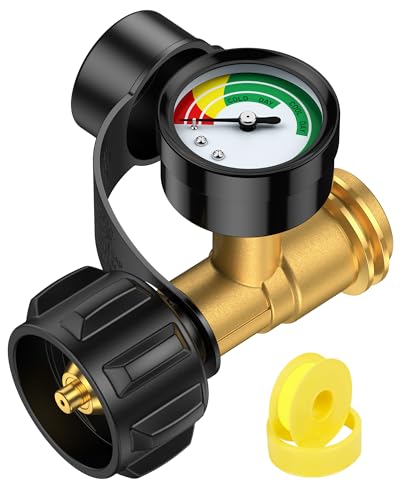
The GasXpert gauge is designed for 5–40 lb DOT propane tanks with a QCC Type 1 inlet and a QCC or POL female outlet. It provides a color-coded reading system (green, yellow, red) and includes three temperature scales to adjust for ambient conditions. Best for: grills, heaters, and camp stoves where quick level awareness matters.
Limitation: designed for propane tanks; verify compatibility with non-propane containers before use.
Buying Guide
Key purchase considerations to guide your choice:
- Tank type and orientation: Choose a gauge built for horizontal cylindrical tanks with flat heads if that matches your setup, or select a vertical-tank model for residential oil storage.
- Thread size and mounting: Ensure the gauge opening matches your tank (1 ¼” MPT, 1 ½” MPT, 2″ NPT, etc.). Center-mount vs. stem-mount can affect readability and installation ease.
- Float and dial design: Longer floats cover deeper tanks; clear, high-contrast dials improve legibility in dim spaces.
- Material durability: Galvanized steel and HDPE floats are robust for outdoor use; consider corrosion resistance for fuel or oil liquids.
- Compatibility and safety: For propane applications, verify inlet/outlet fittings and temperature adjustments to maintain accuracy and safety.
- Installation considerations: Some gauges require drilling or tapping into the tank end head; check if your tank permits this and whether a professional is advisable.
Frequently Asked Questions
- What is a fuel tank gauge used for?
– It measures the liquid level inside a tank, helping users monitor fuel, oil, or other liquids at a glance. - Can these gauges fit different tank openings?
– Yes, most models specify their MPT or NPT thread size; check yours before purchase. - Are dial gauges suitable for low-light areas?
– Many gauges feature clear, high-contrast dials designed for basements or utility rooms. - Do gauges work with vertical and horizontal tanks?
– Some models are designed specifically for vertical tanks, others for horizontal; match to your tank orientation. - Is professional installation required?
– Depending on the tank and opening, installation may require threading or sealing; consult a professional if unsure. - Are these gauges serviceable or replaceable?
– Most are replaceable as a unit; check with the manufacturer for maintenance options.